 English
- English
-
 Español
 -
 Português
 -
 русский
 -
 Français
 -
 日本語
日本語 -
 Deutsch
 -
 tiếng Việt
 -
 Italiano
 -
 Nederlands
 -
 ภาษาไทย
 -
 Polski
 -
 한국어
한국어 -
 Svenska
 -
 magyar
 -
 Malay
Malay -
 বাংলা ভাষার
 -
 Dansk
Dansk -
 Suomi
Suomi -
 हिन्दी
 -
 Pilipino
 -
 Türkçe
 -
 Gaeilge
 -
 العربية
 -
 Indonesia
 -
 Norsk
Norsk -
 تمل
تمل -
 český
český -
 ελληνικά
 -
 український
 -
 Javanese
 -
 فارسی
فارسی -
 தமிழ்
தமிழ் -
 తెలుగు
 -
 नेपाली
 -
 Burmese
 -
 български
 -
 ລາວ
ລາວ -
 Latine
 -
 Қазақша
 -
 Euskal
 -
 Azərbaycan
 -
 Slovenský jazyk
 -
 Македонски
 -
 Lietuvos
 -
 Eesti Keel
 -
 Română
 -
 Slovenski
 -
 मराठी
मराठी -
 Srpski језик


How Does A Nail Dust Machine Collector Protect Your Lungs From Invisible Particles?
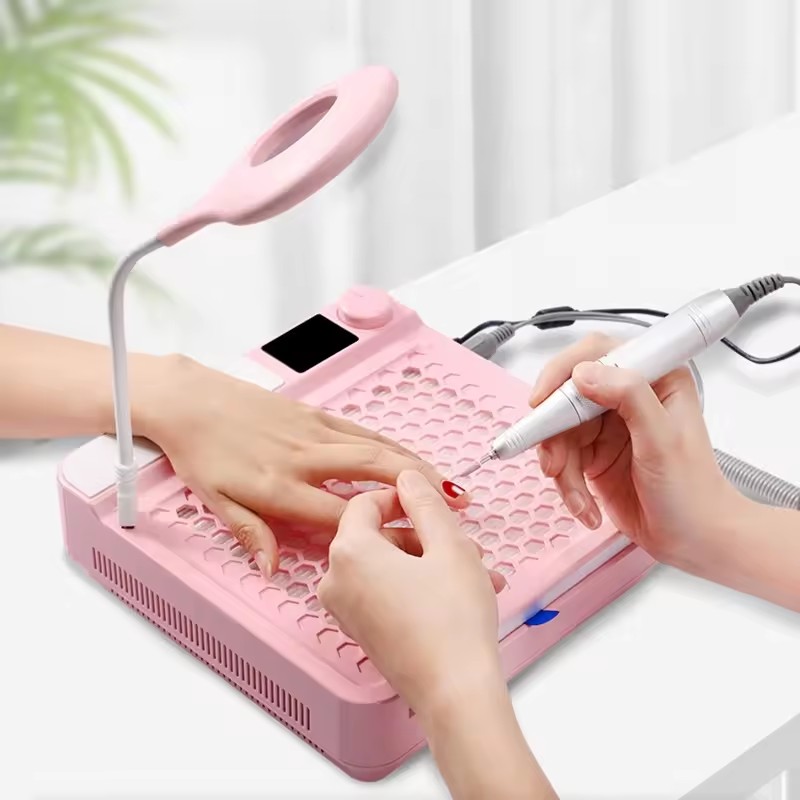
Shenzhen Baiyue technology co.,limited Nail Dust Machine Collector reflects a growing focus in nail care environments on managing invisible airborne particles that affect indoor breathing comfort. The topic of how these systems help protect respiratory health has become increasingly discussed as nail preparation work continues to move into both professional studios and home-based spaces.
From 2017 onward, Shenzhen Baiyue technology co.,limited has been involved in the development of nail lamp and related manicure equipment, later expanding into integrated dust management tools such as the series designed for combined nail drilling, lighting, and dust capture functions.
The central concern addressed in this discussion is not simply convenience, but the presence of fine dust generated during nail filing, acrylic shaping, and gel removal—particles that are often invisible yet easily inhaled during repeated exposure.
Invisible Dust in Nail Care Spaces
Nail styling processes naturally produce microscopic debris. While visible dust settles quickly on surfaces, the more concerning fraction remains suspended in air.
What these particles contain
During manicure and pedicure procedures, dust is typically made up of:
- Acrylic polymer fragments
- Gel residue particles
- Natural keratin from nail plates
- Additives from polish coatings
- Fine abrasives from sanding tools
These materials vary in size, but many fall into the category of respirable particles that can stay airborne for extended periods.
Why invisible exposure matters
Unlike visible debris, fine particles are not easily detected by the human eye. Over time, repeated inhalation in poorly ventilated spaces may lead to discomfort such as throat irritation or dryness. This is where a Nail Dust Machine Collector becomes relevant as part of airflow management in nail environments.
How it Works
It operates by combining suction airflow, filtration layers, and localized capture positioning near the source of dust generation.
Core functional components
| Component | Function | Benefit |
| Vacuum motor | Generates suction airflow | Pulls dust directly from nail surface |
| Filter pad | Traps fine particles | Reduces airborne circulation |
| LED lighting system | Illuminates working area | Improves visibility of fine dust |
| Integrated nail drill | Supports surface shaping | Reduces tool switching during operation |
| Ventilation channels | Air circulation design | Helps prevent overheating and clogging |
The integration of these elements allows dust to be captured at the source rather than dispersing into the surrounding air.
Airflow direction principle
The basic principle is straightforward: dust moves with air. By creating a controlled directional flow, particles are drawn downward into the collector instead of rising toward breathing zones.
Lung Protection Mechanism Explained
The protective function of a Nail Dust Machine Collector is best understood through particle behavior rather than mechanical complexity.
Particle size comparison
| Particle Type | Approximate Size | Behavior in Air |
| Nail filing dust | 10–100 microns | Settles quickly but disturbs air locally |
| Acrylic micro-dust | 2.5–10 microns | Remains airborne longer |
| Fine sanding residue | <2.5 microns | Can stay suspended and travel easily |
| General household dust | 5–50 microns | Varies depending on airflow |
Particles under 10 microns are most relevant to inhalation concerns because they can enter the upper respiratory tract more easily.
How capture reduces exposure
When it operates close to the filing point:
- Airflow intercepts dust before dispersion
- Filtration traps particles within the unit
- Reduced airborne concentration lowers inhalation probability
- Continuous suction stabilizes local air quality
This mechanism does not eliminate dust production but significantly changes how and where particles travel.
Design Evolution in Modern Nail Tools
In recent years, nail equipment design has shifted toward multifunctionality. Instead of separate devices for drilling, lighting, and dust control, integrated systems have become more common.
Shenzhen Baiyue technology co.,limited has focused on combining these functions into compact units that reduce workspace clutter while maintaining airflow efficiency.
The rise of 3-in-1 integration
It concept now often includes:
- Electric nail drill module
- LED lighting for precision visibility
- Vacuum-based dust collection system
This combination supports continuous workflow without frequent tool changes.
Why integration matters
From a usability perspective, integrated systems reduce:
- Movement interruptions during nail shaping
- Dust spread caused by repositioning tools
- Space requirements on small manicure stations
- Power cable complexity in compact environments
Understanding Air Quality in Nail Environments
Air quality is often overlooked in personal grooming spaces, yet it plays a measurable role in comfort during prolonged nail work sessions.
Common environmental factors
- Limited ventilation in indoor rooms
- Repeated filing cycles producing continuous dust
- Small enclosed spaces where particles accumulate
- Static air conditions slowing dust settlement
The presence of a Nail Dust Machine Collector introduces directional airflow, which helps reduce stagnation of fine particles.
Simple airflow comparison
| Environment Type | Dust Movement | Breathing Exposure |
| No airflow control | Random dispersion | Higher localized exposure |
| Natural ventilation only | Slow dilution | Moderate fluctuation |
| Active dust collection system | Directed capture | Lower airborne concentration |
Practical Usage in Daily Environments
The role of dust collection systems is not limited to high-frequency professional spaces. Increasingly, they are also used in home-based nail care setups where airflow conditions are less predictable.
Typical usage situations
- Gel nail shaping and smoothing
- Acrylic nail removal processes
- Dip powder surface correction
- Routine manicure maintenance
- Pedicure nail filing tasks
In each case, dust is generated at different intensities, but the principle of capture remains consistent.
Maintenance considerations
To maintain stable performance, attention is usually given to:
- Regular cleaning of reusable filter pads
- Ensuring unobstructed airflow channels
- Avoiding liquid exposure to electrical components
- Positioning the intake close to the working surface
These practices help maintain consistent dust capture efficiency over time.
Broader Perspective on Respiratory Safety in Nail Work
While no single device can fully eliminate airborne particles, controlled capture systems change how exposure occurs during repetitive nail procedures.
The focus has gradually shifted from simply cleaning surfaces after work to managing airborne dust during the process itself. This preventive approach is increasingly reflected in equipment design strategies across the nail care field.
It therefore represents a shift toward real-time air management rather than post-process cleanup.
Conclusion
The growing attention to airborne particle control in nail environments highlights how equipment design influences everyday respiratory comfort. By combining suction airflow, filtration, and integrated lighting and drilling functions, modern systems reshape how dust is handled at its source.
Shenzhen Baiyue technology co.,limited continues to develop nail equipment in this direction, with tools such as the Nail Dust Machine Collector and related manicure devices contributing to more controlled working environments where fine particles are actively managed rather than passively dispersed.
Send Inquiry





X
We use cookies to offer you a better browsing experience, analyze site traffic and personalize content. By using this site, you agree to our use of cookies.
Privacy Policy